
Ubud Monkey Forest
Complete Ubud Monkey Forest Information Guide
Ubud Monkey Forest, officially the Sacred Monkey Forest Sanctuary in Padangtegal, combines free-ranging long-tailed macaques, tropical forest paths and active Balinese sacred spaces in central Ubud.
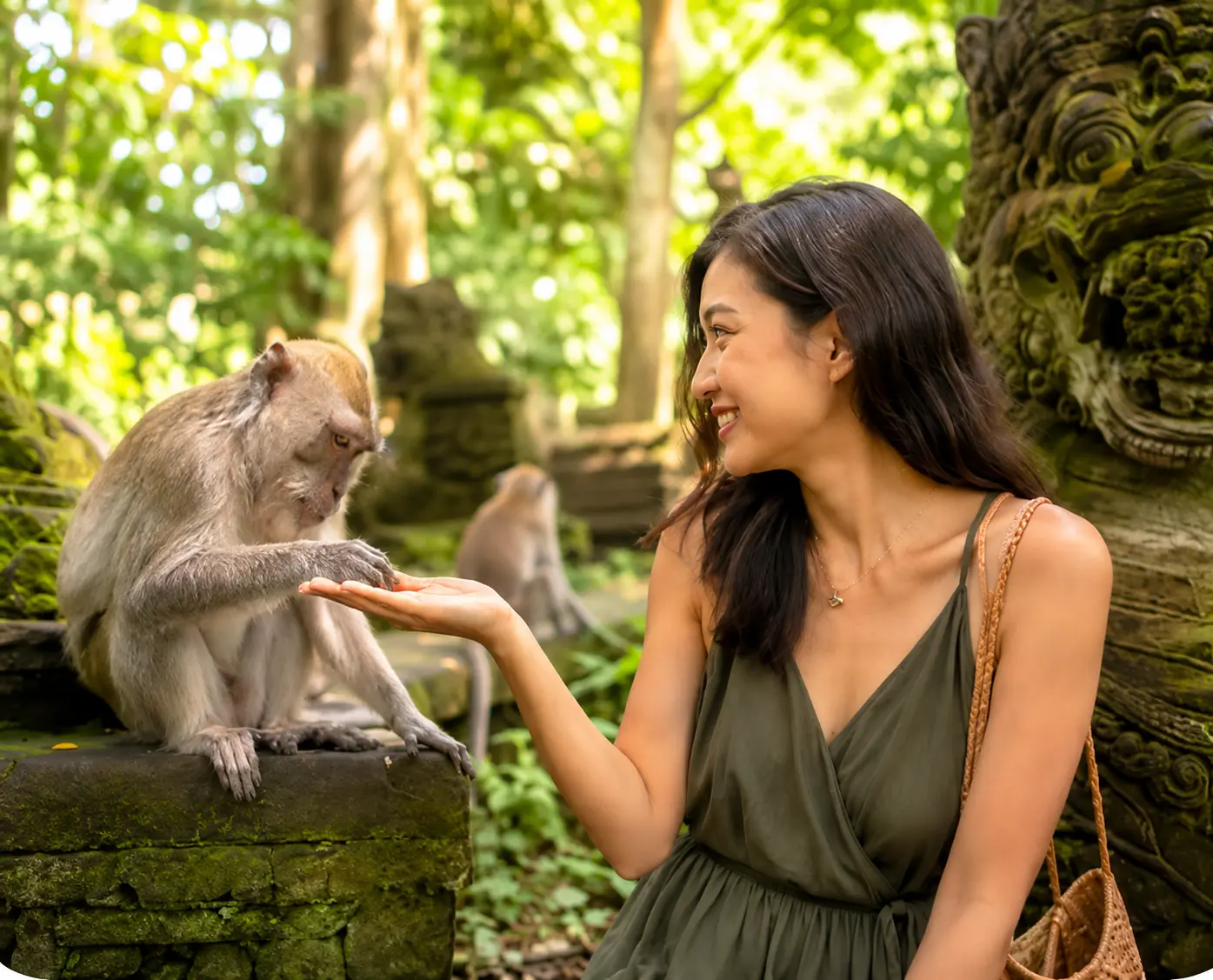
UBUD MONKEY FOREST
Explore This Guide
Jump directly to the information you need.
What to Know Before Visiting Ubud Monkey Forest
Treat Ubud Monkey Forest as both a wildlife sanctuary and a sacred Balinese place rather than a petting attraction.
The macaques move freely through visitor areas, while several temple spaces remain reserved for local religious use. The main decisions are when to visit, whether you need simple admission or a guided format, how you will reach central Ubud and whether everyone in your group is comfortable with macaques coming relatively close.
Ubud Monkey Forest Quick Facts
| Practical detail | What to expect |
|---|---|
| Official name | Sacred Monkey Forest Sanctuary, also known as Ubud Monkey Forest |
| Location | Jalan Monkey Forest, Padangtegal, Ubud 80571 |
| Published opening hours | 09:00–18:00 |
| Last entrance | 17:00 |
| Current official entrance fee | IDR 130,000 adult; IDR 100,000 child |
| Typical visit | About 1–2 hours |
| Forest | About 12.5 hectares with 186 recorded tree species |
| Macaques | More than 1,000 long-tailed macaques in several social groups |
| Sacred places | Three principal temple areas; access to sacred interiors is restricted |
| Facilities | Toilets, parking, lockers, security, first aid and an animal clinic |
| Main visitor rule | Do not touch or feed monkeys; secure loose belongings and avoid direct eye contact |
| Booking | Official online admission is available; guided visits and transport are optional |
Is Ubud Monkey Forest Worth Visiting?
Yes, when you want a central-Ubud attraction combining free-ranging macaques, tropical forest and Balinese sacred spaces in one relatively compact visit.
It is particularly suitable when:
- You want close wildlife observation: macaques move throughout the visitor areas rather than remaining behind conventional zoo barriers.
- You are already spending time in Ubud: the sanctuary is inside the town rather than requiring a separate remote excursion.
- You want a manageable attraction: most visitors can see the principal areas in roughly one to two hours.
- You are interested in more than monkeys: forest, temples, stone sculptures and Balinese cultural context are important parts of the sanctuary.
- You prefer flexibility: the attraction can be explored independently without requiring a guide.
It may be better to skip it when:
- You are strongly afraid of monkeys: keeping substantial distance from every macaque is difficult.
- A child cannot reliably follow instructions: running, touching animals or carrying food can create avoidable problems.
- You need confirmed fully step-free access: the available visitor information does not establish a fully step-free route through the entire forest.
- You expect unrestricted temple access: an entrance ticket does not provide access to every sacred structure.
- You want an isolated wildlife reserve: this is a major attraction in central Ubud and can feel busy.
Tickets, Opening Hours & Entry
The sanctuary currently publishes opening hours of 09:00–18:00, a last entrance at 17:00, and admission of IDR 130,000 for adults and IDR 100,000 for children.
Prices and ticket classifications can change. The public visitor page currently lists a child price but does not state the child-age band, so families should confirm the applicable age definition before payment.
Can You Buy Tickets Online?
Yes. The sanctuary operates an official online ticket system, and third-party platforms also list admission, guided visits and transport-inclusive products.
View official Monkey Forest Ubud visitor information →
View the official online ticket route →
Admission Ticket or Guided Tour?
Choose entry only when you are already in Ubud and comfortable exploring independently; choose a tour when cultural interpretation or organised transport adds genuine value.
- Entry only: straightforward for independent visitors using the official map, signs and on-site staff.
- Ticket with guide: useful when you want more explanation of the macaques, temples and local cultural context.
- Tour with transport: practical when Monkey Forest is one stop within a wider Ubud day from another part of Bali.
Planning Your Ubud Monkey Forest Visit
Plan the visit around the sanctuary's opening window, your transport into central Ubud and how comfortable your group is around free-ranging macaques.
When Is the Best Time to Visit?
Arriving near opening time is the simplest choice when you prefer cooler conditions and plenty of time before the 17:00 final entrance.
The forest offers substantial shade, but Ubud can still be warm and humid. Crowd levels vary, so an early arrival should not be treated as a guarantee of an empty sanctuary.
How Long Should You Allow?
Allow around one to two hours for a normal first visit.
- About one hour: a focused walk through the principal visitor areas.
- About 90 minutes: a comfortable amount of time for most first visits.
- Up to two hours or more: useful when you stop frequently for photographs or explore more of the forest paths.
Getting There & Parking
Ubud Monkey Forest is in Padangtegal on the southern side of central Ubud, so walking can be the easiest option when you are already staying nearby.
- Walking: practical from many central-Ubud hotels, restaurants and shops.
- Taxi or ride-hailing: useful for a single visit.
- Private driver: useful when combining the sanctuary with attractions outside central Ubud.
- Scooter: use only when appropriately licensed and comfortable with Ubud traffic.
- Parking: the official sanctuary map identifies parking areas and a dedicated parking building.
What Should You Wear and Bring?
Wear practical walking footwear, dress respectfully and carry as few loose objects as possible.
- Footwear: use shoes or secure sandals with useful grip.
- Clothing: modest, comfortable clothing suits the climate and sacred setting.
- Bag: use a securely closing bag.
- Small objects: keep sunglasses, jewellery and other loose belongings secure.
- Food and drinks: do not carry food into the forest.
What Facilities Are Available?
- Toilets
- Parking
- Lobby lockers
- First-aid clinic
- Animal clinic
- Security
- Visitor rest areas
What to Expect Inside Ubud Monkey Forest
Ubud Monkey Forest is a functioning sacred landscape as well as a place to observe macaques. Forest paths connect temple areas, bridges, statues, ravines and visitor facilities while the animals move freely through much of the sanctuary.
The Long-Tailed Macaques
The monkeys are Balinese long-tailed macaques, scientifically known as Macaca fascicularis.
The sanctuary reports a population of more than 1,000 animals divided into several social groups. They live in a semi-wild environment and should not be treated as domesticated animals.
Temples, Sacred Areas & Tri Hita Karana
The temples are an essential part of the sanctuary rather than a decorative backdrop to the monkeys.
The sanctuary connects its purpose with the Balinese concept of Tri Hita Karana: harmony between people and the divine, between people themselves, and between people and the natural environment.
Do You Need a Guide at Ubud Monkey Forest?
No. Most visitors can explore Ubud Monkey Forest independently. A guide becomes more useful when cultural interpretation, extra reassurance around the macaques or organised transport matters more than simply entering the sanctuary.
Monkey Safety & Suitability
The safest way to experience Ubud Monkey Forest is to observe rather than interact.
- Do not touch or pick up monkeys.
- Do not feed them.
- Avoid direct eye contact.
- Stay calm and do not run.
- Secure bags and loose belongings.
- Keep children close.
Is Ubud Monkey Forest Suitable for Children?
Yes for many families, but suitability depends on whether the child can reliably follow the rules around free-ranging animals.
Children should remain close to an adult and should not run towards, touch or feed the macaques. If a child is frightened by animals approaching closely, the visit may not be enjoyable.
Accessibility, Strollers & Limited Mobility
Do not assume every part of the sanctuary is fully step-free. Visitors who require wheelchair, stroller or step-free access should confirm the current suitable route before travelling.
What Should You Do After a Monkey Bite or Scratch?
Take any bite or scratch seriously, even when the wound appears small.
- Tell sanctuary staff immediately.
- Wash the wound thoroughly with soap and running water for around 15 minutes.
- Seek prompt medical assessment for appropriate wound, tetanus and rabies post-exposure advice.
What Combines Well with Ubud Monkey Forest?
The best combinations either stay in central Ubud or continue in one logical direction rather than jumping between distant parts of Bali.
| Combination | Practical fit |
|---|---|
| Ubud Palace + Ubud Art Market | Easy central-Ubud combination |
| Tegalalang Rice Terrace + Bali Swing | Natural choice when continuing north |
| Rafting or ATV | Useful when you want a more active day |
| Tegenungan Waterfall | Possible when using private transport around the wider Ubud area |
Frequently Asked Questions
Is Ubud Monkey Forest the Same as the Sacred Monkey Forest Sanctuary?
Yes. Ubud Monkey Forest is the common visitor name for the Sacred Monkey Forest Sanctuary in Padangtegal.
Is the Monkey Selfie Included in the Entrance Ticket?
No. The sanctuary currently lists its supervised monkey-selfie activity separately.
Can Visitors Enter the Temples?
Not as ordinary sightseeing interiors. Visitors should follow the sanctuary's signs and staff instructions around sacred areas.
Are Lockers Available?
Yes. The sanctuary provides lockers in the visitor area.
Related Experiences
A natural next stop when continuing north from central Ubud, with terraced landscapes and a very different type of visit.
A more activity-focused addition around the wider Ubud and Tegalalang area.
A useful option when you want to add a longer active experience to an Ubud day.
Final Advice
Choose Ubud Monkey Forest when you are comfortable being close to free-ranging macaques and want wildlife, forest scenery and Balinese sacred spaces in one central-Ubud attraction.
Allow roughly one to two hours, keep belongings securely stored, follow the no-touching and no-feeding rules, and treat the temple areas as active sacred places rather than sightseeing props.
Booking & Local Assistance
For current admission and guided options, use the dedicated Ubud Monkey Forest booking page on BestBaliActivities.com, or contact Best Bali Adventures when personalised local help, transport or a wider Ubud plan is useful.
Explore the Best Bali 4 U Network
If Ubud Monkey Forest is part of a wider Bali trip, these connected guides and planning resources are useful next steps.
Questions About This Guide?
Contact the editorial team if you have a question about this guide, have noticed information that should be corrected or updated, or would like to contribute reliable local knowledge, suggestions or feedback.